CASE STUDY: Protect Trade


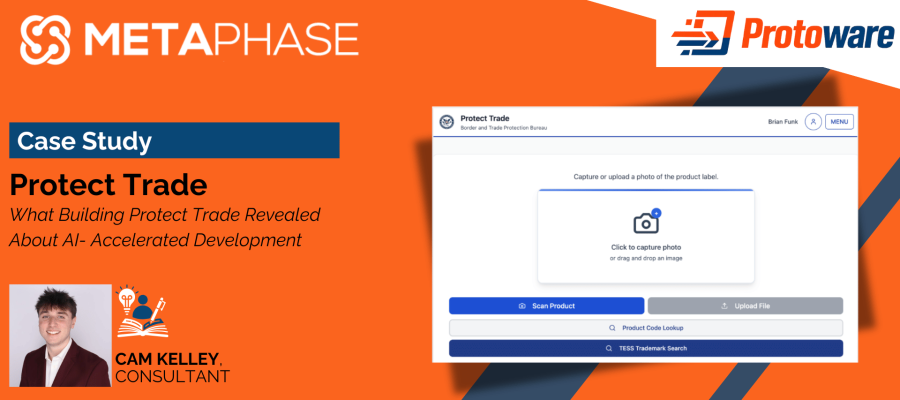
What Building Protect Trade Revealed About AI-Accelerated Development
By Cam Kelley, Consultant
Innovation is often measured by the technology itself. Just as important, however, is what a team can accomplish when the timeline is short, the challenge is real, and the expectations are high.
That was the premise behind Protect Trade, an intern-led prototype designed to mirror the type of work delivery teams face in real client environments. The project began with an RFP-style challenge, a formal pitch, and the expectation that a small team would move from concept to working solution within eight weeks.
The selected concept focused on counterfeit goods detection and trade enforcement. It was a practical use case that combined workflow automation, analytics, and applied AI while reflecting the kind of mission-driven software organizations increasingly need. It also created an opportunity to explore how AI could accelerate both the development process and the product itself.
The Challenge Was Bigger Than the Timeline
The timeline alone made the assignment ambitious. Building a functional platform with secure access, data integrations, analytics, and a polished user experience would typically require months of work from experienced teams.
The challenge became even greater when paired with the realities of the team. The four interns were early in their academic careers, entering the project with classroom experience but limited exposure to the pace, ambiguity, and troubleshooting demands of a real delivery environment.
Success would require more than technical skill. It would require adaptability, collaboration, and the ability to learn quickly under pressure.
Building Like a Real Delivery Team
Protect Trade was structured to reflect how effective product teams operate.
Daily standups, sprint recaps, mentorship, and iterative checkpoints created a delivery rhythm centered on accountability and progress. The team approached the work by leaning into individual strengths, identifying gaps early, and ensuring momentum never stalled.
When one area encountered blockers, effort shifted elsewhere. If backend issues required deeper troubleshooting, other team members advanced API connections, interface improvements, or supporting features. That parallel approach kept development moving and reinforced an important lesson about modern delivery teams: sustained progress often comes from coordination as much as coding.
The project also demanded a willingness to learn in real time. New tools, unfamiliar systems, and evolving requirements became part of the process rather than obstacles to it.
Where AI Made the Biggest Difference
AI played a central role in both the product vision and the speed of execution.
Within the prototype itself, AI supported image recognition and counterfeit detection, with a continuous learning model designed to improve accuracy as the underlying data set expanded over time.
Behind the scenes, AI significantly accelerated development. Figma helped shape the early user experience. Loveable transformed design concepts into functional front-end pages quickly. ChatGPT and Windsurf were heavily used to speed coding, troubleshoot issues, and connect technical components across the platform.
That combination allowed the team to compress work that might traditionally take months into an eight-week build cycle.
AI did not remove complexity. There were moments when generated solutions required substantial debugging or backtracking. But it consistently reduced friction and helped the team move through technical hurdles faster than traditional methods would have allowed.
What the Team Delivered
The final result was a functional prototype that demonstrated how quickly a credible product can be built when the right tools and team dynamics come together.
Protect Trade included single sign-on, role-based access, live data integrations, dashboards, interactive mapping, and a user experience built to move from input to insight. It brought multiple capabilities into one cohesive system and showed how applied AI could support both internal efficiency and end-user functionality.
More importantly, it proved that meaningful software can emerge quickly when execution is focused and continuous.
Why the Outcome Mattered
The final prototype was presented to a federal CIO as well as MetaPhase executive leadership.
The reception mattered because it validated the substance of what had been built. The presentation showed that Protect Trade was more than a surface-level demonstration. It was a working product with real functionality, practical use cases, and room for future growth.
Just as importantly, it demonstrated that a four-person intern team working under tight deadlines could confidently present a serious solution to senior stakeholders. With AI accelerating the development process, a team early in its career journey was able to deliver work that could stand in conversations typically reserved for far more mature efforts.
The project also became a launch point for the interns involved. Following the program, team members moved into strong next steps that included full-time roles, competitive internships, and continued academic and professional success.
What Protect Trade Revealed
Protect Trade was developed as a prototype to test ideas, simulate delivery pressure, and explore what modern development can look like. In doing so, it demonstrated how quickly meaningful software can be built when AI is integrated thoughtfully into the process.
The broader takeaway extended beyond a single product or use case.
AI can help compress timelines, while meaningful outcomes still depend on how teams communicate, adapt, divide responsibilities, and continue learning when challenges arise.
When those elements come together, smaller teams can move faster, build more than expected, and deliver results that carry lasting weight.