CASE STUDY: OpenComments


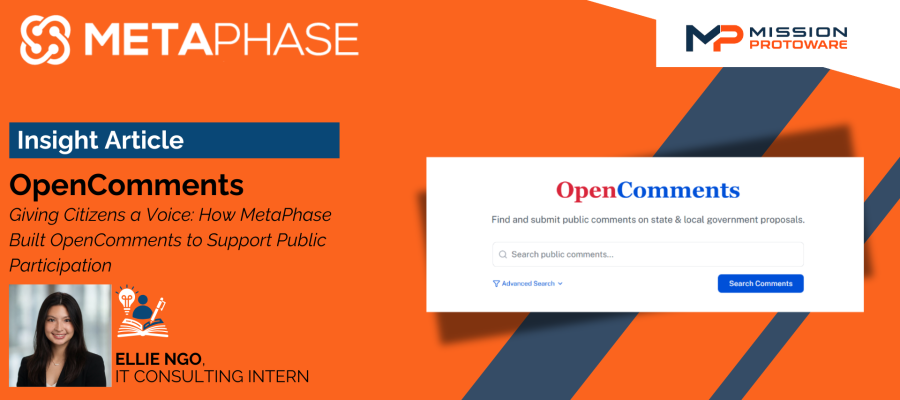
Giving Citizens a Voice: How MetaPhase Built OpenComments to Support Public Participation
By Ellie Ngo
Have you ever disagreed with a proposed regulation, policy change, or local government decision and wondered how to make your voice heard?
Public comment periods are a cornerstone of government transparency by providing citizens, advocacy organizations, researchers, and businesses opportunities to provide feedback before important decisions are finalized. While federal agencies often rely on established platforms such as Regulations.gov to collect and manage public comments, state and local governments frequently have fewer resources and fewer technology options available to support the same process.
That challenge inspired OpenComments, an open-source public commenting platform created by MetaPhase to explore how smaller government organizations could modernize the way they collect and manage public feedback. What began as a civic technology project quickly became an opportunity to examine the challenges behind public participation and the systems required to support it effectively.
Building OpenComments at CivicHack DC 2025
OpenComments was created during CivicHack DC 2025, an event put on by Civic Tech DC, a non-partisan nonprofit that brings together technologists, designers, and public-sector professionals to address civic challenges. MetaPhase participated as part of its ongoing commitment to public-sector innovation and civic engagement.
Working within a single-day event lasting approximately eight hours, the team focused on a challenge that often receives less attention than comment analysis and moderation: how comments are collected in the first place. Using ChallengeAI to accelerate development, the team created an MVP that demonstrated a modern approach to public comment collection for state and local governments.
Supporting State and Local Government Participation
Public participation processes often receive attention at the federal level, but state and local agencies face many of the same challenges when gathering feedback from the communities they serve.
Whether an agency is proposing a new regulation, updating existing requirements, or seeking public input on a policy decision, collecting and organizing comments requires more than simply providing a submission form. Citizens need access to context and supporting information, while agencies need ways to manage submissions, comment periods, and related documentation.
One of the earliest lessons from the project was that public commenting is fundamentally an information management challenge. When people think about public participation, they often focus on the act of submitting feedback. In reality, comments exist within a broader framework that includes agencies, dockets, supporting documents, regulatory filings, deadlines, review processes, and historical records. What began as a project centered on collecting public feedback gradually evolved into a model for managing relationships between these interconnected elements. As development progressed, the team found that modeling those relationships required significantly more thought than initially anticipated, reinforcing the importance of organizing information in a way that makes participation easier rather than more complex.
The MVP demonstrated that MetaPhase's approach to modernizing public comment collection is both viable and adaptable. By modeling many of the core relationships involved in public participation, OpenComments established a foundation that could support future enhancements. Capabilities such as configurable rules engines, API integrations with external government systems, workflow automation, and expanded administrative tools could further streamline what is often a multifaceted and highly interconnected process, making participation easier for both agencies and the public.
The experience reinforced a lesson that extends well beyond civic technology. The visible interface is often only a small part of a successful digital service. Behind every streamlined experience is a framework that organizes information, manages relationships, and helps users navigate complexity without being overwhelmed by it. In many ways, OpenComments demonstrated that the challenge of public participation is not simply collecting comments but structuring the information surrounding those comments in a way that makes them meaningful.
Open Source by Design
OpenComments was developed as an open-source initiative, with the repository publicly available to encourage collaboration and future development. Built using technologies including React, PostgreSQL, Node.js, Tailwind, and Playwright, the project reflects MetaPhase's belief that open-source solutions can help state and local governments explore new approaches to modernization without starting from scratch.
Designing for Participation
Another important lesson from the project involved understanding how different audiences interact with public participation systems. Agencies, researchers, advocacy organizations, and citizens all approach the same information with different goals and expectations, reinforcing the importance of designing experiences that remain accessible without oversimplifying the underlying process.
Throughout development, the team continually returned to a simple principle: technology should serve the mission, not the other way around. The goal was to explore how complex regulatory information could be presented in a way that feels approachable to a broad range of users, not to build technology for its own sake. Effective participation depends not only on access to information, but also on helping people understand how that information fits into a larger process and where their contributions can have an impact.
Looking Ahead
OpenComments was created to explore how open-source technology could support public participation while making regulatory information easier to navigate. The project generated valuable insights into organizing information, supporting multiple stakeholder groups, and designing systems that encourage engagement.
The lessons learned extend beyond any single platform. As governments continue to modernize digital services, success will depend not only on digitizing existing processes but also on designing experiences that help people understand and participate in them. OpenComments reinforced a simple but important idea: meaningful public participation begins with access to information, but it succeeds when that information is structured in a way that people can actually use.