CASE STUDY: FedSpeak


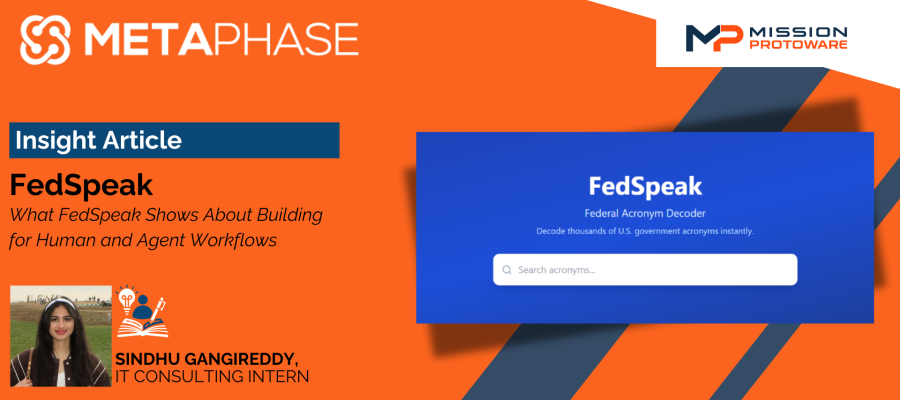
What FedSpeak Shows About Building for Human and Agent Workflows
By Sindhu Gangireddy, IT Consulting Intern
Federal work has its own language.
Try reading a government document filled with terms like ATO, FISMA, CUI, FedRAMP, IDIQ, SBIR, CMMC, or NIST SP 800-53. For people who already work in federal environments, these acronyms may feel routine. For everyone else, they can stop a sentence cold. That challenge becomes even more important as AI systems begin supporting public sector work. If a person can struggle to understand which meaning of an acronym applies, an AI agent can struggle too. The issue is not only what an acronym stands for. The issue is what it means in the specific agency, program, policy, or technical context where it appears. FedSpeak (https://fedspeak.dev) was built by MetaPhase to address that problem in a practical way: make federal acronyms easier to decode, easier to access, and easier for both people and systems to use.
Defining the Problem
Federal terminology often assumes prior knowledge. That creates problems for new team members, contractors, technical users, students, and anyone working across unfamiliar agencies or programs. It also creates a real challenge for AI agents being used in federal workflows. If an acronym is unclear, the meaning of an entire requirement, policy reference, or workflow step can become uncertain. A term may refer to a system in one context, a compliance requirement in another, or an office, policy, contract vehicle, or program somewhere else. A human reader can sometimes pause, search, or ask someone for clarification. An AI agent needs a more reliable way to resolve that ambiguity while continuing its task.
FedSpeak addresses that issue through acronym decoding designed with both people and agents in mind. A user can look up an unfamiliar term and get a clearer explanation. An agent or system can access the same information through a direct technical interface, making the tool easier to use inside automated workflows rather than only as a static reference page.
Built at the DMV NANDA Hack
FedSpeak was built during one of MetaPhase’s recent local hackathon engagements, the DMV NANDA Hack at George Mason University. This was a regional event connected to Project NANDA.
Project NANDA is an open-source initiative out of the MIT Media Lab focused on the “Internet of AI Agents,” or the infrastructure that allows AI agents to discover, communicate, verify capabilities, and coordinate with one another. At the hackathon, many participants focused on building agents or connecting agents to public APIs. MetaPhase took a different approach. Instead of only building an agent, the team built something useful for agents to call. They worked on a public-sector reference tool that helps both people and AI systems interpret federal acronyms more accurately.
That distinction matters. AI agents are only as useful as the tools and information they can reliably access. FedSpeak gives agents a concrete public-sector use case. When they encounter an unfamiliar federal acronym, they can query a working service instead of guessing from context alone.
The prototype was built quickly. The full project came together in one day, and the website itself was built in roughly three hours. Even with that short timeline, the result was more than a demo page. FedSpeak includes a working database, web lookup experience, API, and CLI, making it usable by humans, developers, and AI systems.
The project also reflects the kind of local ecosystem MetaPhase continues to support, including universities, nearby companies, technical communities, and students building around emerging AI infrastructure. FedSpeak is small, but it shows how fast a practical public-sector tool can move from idea to working prototype when the right team is focused on a clear use case.
Built for More Than Browsing
FedSpeak is designed as more than a glossary. The website gives people a straightforward way to look up unfamiliar federal terms. The API and CLI make the same information available to agents, applications, and technical users. That design choice matters because people and AI systems do not use information the same way. A person can search, read, compare, and decide what fits. An AI agent needs a cleaner path: request information, receive a structured response, and continue the task. The CLI also gives developers a fast way to test the tool, integrate it into workflows, or connect it to other systems. That makes FedSpeak more flexible than a static reference page.
FedSpeak is also open source. By making the code public, MetaPhase made the tool available for developers, students, agencies, and AI builders to inspect, use, and extend. That openness reflects a practical confidence in the work. FedSpeak was built quickly, but it was built well enough to share. That openness is part of the point of the project. Federal knowledge becomes more useful when it is easier to access, reuse, and connect to other tools.
What FedSpeak Shows About MetaPhase
For MetaPhase, FedSpeak is less about the size of the tool and more about the pattern behind it. Government technology can no longer be designed only around a person clicking through a website. People still need clear interfaces, but AI agents and automated workflows need reliable ways to reach the same information. FedSpeak shows how MetaPhase thinks about that shift by building tools that are useful to humans, structured enough for machines, and practical enough to work in real environments. It also shows speed. In a short hackathon window, MetaPhase built a working product with a real public-sector use case, not just a concept. This shows how quickly they turned a familiar government pain point into something functional, accessible, and extensible.
The Larger Takeaway
As AI agents become part of government workflows, they will need tools that help them understand the language of the environments they operate in. Acronym decoding is one example, but the same idea applies to policies, forms, compliance terms, acquisition language, program names, and other specialized vocabulary across federal work. FedSpeak starts with a narrow problem, but points to a larger question for government technology: how should public sector systems make knowledge easier to use for both people and the tools working alongside them?